
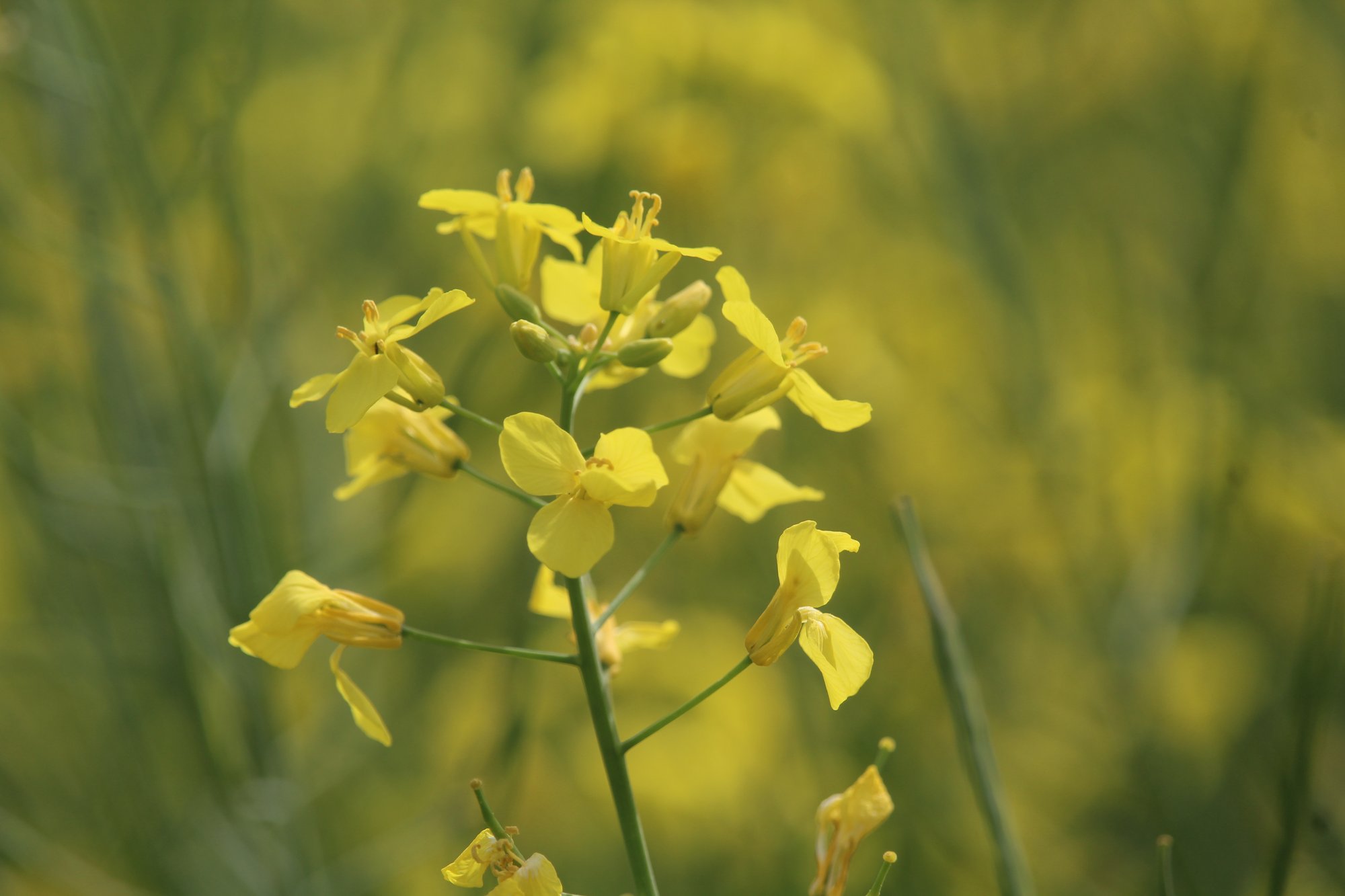
Key benefits of growing canola include:
-
Crop rotation
Canola is a broadleaf crop that introduces diversity, particularly in the cereal-dominated cropping systems common to the PNW.
-
Chemical rotation
Growing canola provides an opportunity to use herbicides not used in cereal rotations.
-
Improved weed management
Different chemistries and timing can significantly improve control of problem weed populations and decrease herbicide resistance.
-
Yield increase in subsequent wheat/cereal crop
Most growers report improved yield the year after canola, and often two years after.
-
Economics
Canola markets have held fairly steady compared to wheat and garbanzo beans; most enterprise budgets show a positive bottom line with canola in rotation.
-
Break disease and pest cycles
Canola serves as a 'break crop' where disease and pests have built up to economically damaging levels.
-
Irrigation timing
In deficit irrigation systems, canola needs less water, and at different times than potatoes or wheat.
-
Improved soil structure and health
The taproot breaks up tillage and hard pans; the root system accesses nutrients not available to wheat roots.
-
Snow capture and residue decomposition
Standing stalks capture snow and decompose readily, allowing easier no-till seeding.
-
Increased water infiltration
The canola taproot opens channels for water movement, reducing erosion risk.
-
No need to purchase new equipment
Modifications may be needed, but existing wheat equipment can be used.
-
LOCAL demand
Processors in MT and WA reduce transportation costs for many PNW growers.
Field History Herbicide history, bioassay steps, rotational restrictions
The single most important detail to know before planting canola is the herbicide history of the field, preferably from at least 3–5 years prior. Canola is very sensitive to Group 2 herbicides (ALS inhibitors — imidazolinone (IMI) and sulfonylurea (SU)). IMIs degrade faster at higher soil pH while SUs persist longer in higher pH soil.
Herbicide residual tolerant varieties are available, but field history still needs to be known to make accurate variety selection decisions. If the ground has been recently acquired and chemical history is unknown, conduct a bioassay before committing to an entire field.
Bioassay Steps
-
Plan ahead — a bioassay should be done a minimum of 30 days ahead of seeding to observe plant injury and allow time for variety selection decisions.
-
Collect several soil samples from the field in question and mix well. Do the same from a field known to be free of Group 2 herbicides. Samples from the top 3" of soil (unless cultivated deeper). Keep samples separate. Collect enough to fill several 4" pots per field.
-
Plant susceptible and herbicide tolerant canola seeds in both sets of pots. Place in a sunny window or greenhouse. Keep soil moist but not waterlogged.
-
Let plants grow 2–4 weeks. Observe symptoms on leaves, stems, and roots — yellowing, stunting, or other abnormalities.
-
Once presence or absence of residual herbicide is determined, choose the variety that will perform best on your farm.
"Always question your fieldman: 'what windows will I close if I use that chemical?'"
– Steve Swannack, Lamont, WA
Resources
Rotational Restrictions for Canola
Herbicide Carryover Info Sheet
Herbicide Classification Poster
Industry Contacts
- Silver
- Associate
- Associate
- Associate
- Silver
- Associate
- Silver
- Associate
- Gold
- Platinum
- Silver
- Gold
- Associate
- Associate
- Associate
- Silver
Northwest Grain Growers
Associate-
Variety Selection Hybrid vs. open-pollinated, traited systems, GMO/non-GMO
Winter and spring canola genetics have improved considerably in the last 5–10 years. The number of hybrids and open-pollinated varieties has expanded to include a range of conventional and herbicide-tolerant choices, and specialty canola (high oleic and high omega).
Technology traits for residual herbicide tolerance
-
SURT = SU-Residual Tolerant (not IMI tolerant)
-
Clearfield (CL) = IMI residual tolerant (most are also SU residual tolerant)
Non-GMO options
-
Conventional
-
Clearfield
-
Sulfonylurea-tolerant
GMO options
-
Roundup Ready (glyphosate tolerant)
-
Sulfonylurea-Roundup Ready (SU and glyphosate tolerant)
-
Liberty Link (glufosinate tolerant)
Tailor your final decision based on residual herbicide history, crop rotation, performance, cost, and availability. Note that seed supply can dwindle rapidly based on high demand elsewhere in the country and in Canada.
Required documentation: ID, OR, and WA all require that all canola seed sold have documentation (e.g. phytosanitary certificate, bag tag) declaring the seed to be certified blackleg free. Do not purchase seed that does not have the proper documentation.
Quick Links
"We have never been disappointed with canola in our rotation."
– John Hinnenkamp, Colfax, WA
Industry Contacts
- Associate
- Associate
- Platinum
- Gold
- Silver
- Silver
- Associate
- Gold
- Platinum
- Silver
- Gold
- Associate
- Associate
- Silver
- Associate
- Silver
- Platinum
- Silver
- Gold
- Associate
- Gold
- Silver
- Associate
Economics Enterprise budgets, local markets, processing facilities
Economics matter, and the primary question is whether including canola in rotation will improve your bottom line. With other commodities struggling to remain profitable, canola is certainly worth considering. A simple exercise is an enterprise budget — UI and WSU have developed spreadsheet-based budgets for low and intermediate rainfall regions that allow input of fertilizer costs, land costs, yield, and market price.
The opening and expansion of processing facilities in MT and WA in the last decade have been a game changer for PNW canola producers — providing a local market that reduces transportation costs for many growers and often translating to a steadier market price than elsewhere in the U.S. and Canada.
Quick Link
"Four out of five years I make more money off my canola than my wheat."
– Curtis Hennings, Ralston, WA
"Canola is not always more valuable than wheat until you look at the whole picture."
– Wade Troutman, Bridgeport, WA
Resources
Check back for more resources.
Industry Contacts
- Silver
- Associate
- Associate
- Silver
Planting Equipment, seeding date, plant population, depth, row spacing, calibration
'One size fits all' does not apply. Whether you have a disc drill, an air seeder, a singulating planter, or most other makes and models, it can be used to plant canola. The objective is uniform, consistent seed placement. A critical factor: seed needs to be placed INTO moisture (not just to moisture) so there is moist soil above and below the seed.
Seeding Dates
Winter Canola
Seeding window has widened considerably — mid-July to early September in many PNW areas. In low rainfall wheat-fallow systems, depth to soil moisture often drives timing. Recommended seeding in the Palouse region is before September 10. In the Willamette Valley: mid to late September. Northcentral Oregon: early September. Montana: target August.
Dual-Purpose Canola (Grazing)
Plant in June without fertilization. Use the 'twist and pull' test before turning cattle on — plants should be difficult or impossible to pull from the ground.
Spring Canola
Typically seeded in April or as soon as equipment can enter after snowmelt. Germination slows below 45°F. Seeding later than May is not recommended — hot temperatures during bloom reduce yield. USDA-ARS data shows yield decreased 43 lbs/day for each day seeding was delayed after April 12.
Plant Population
-
Target: 5–8 plants/ft² for spring canola; 4–5 plants/ft² for winter canola
-
Average germination is ~60% — calibrate for 10 seeds/ft² to attain 6 plants/ft²
-
Factor in thousand seed weight (TSW) — printed on every bag of commercial seed
-
Use the Canola Council of Canada seeding rate calculator at canolacalculator.ca
Row Spacing
-
Spring canola: 7–12 inches most common
-
Winter canola: 12–28 inches typical; a 3-year UI study near Genesee found no yield difference between 10" and 20"
-
Wide row spacing not recommended for spring canola due to weed competition before canopy closure
Seeding Depth & Speed
-
Depth: 0.5"–1.5". If moisture is deeper than 1.5" and the drill allows it, do not cover seed with more than 1" of soil.
-
Speed: target 3–4 mph. Faster speed can cause drill bounce and uneven seed distribution.
Quick Links
"The two things I've learned regardless of the drill I've used is to go slow, and to calibrate!"
– PNW canola grower
"Growing canola requires a different way of thinking, from a systems approach — chemical systems, cropping systems, rotational systems."
– PNW canola grower
Resources
The Combine Forum
AgTalk
Successful Stand Establishment (Autumn Barnes, Canola Council of Canada, 2019 PNWCA Workshop)
Industry Contacts
- Partner
- Silver
- Silver
- Associate
- Silver
- Platinum
- Silver
- Gold
- Associate
- Associate
- Gold
- Silver
- Silver
- Associate
- Associate
- Silver
- Silver
- Associate
- Associate
- Silver
- Silver
- Associate
- Associate
- Platinum
- Gold
- Silver
- Platinum
- Silver
- Associate
- Silver
- Gold
- Associate
- Platinum
- Silver
- Gold
- Associate
- Associate
- Gold
- Associate
- Silver
- Agency
- Agency
Northwest Grain Growers
Associate-
Fertilizer Management N, S, P, K, Boron, other micros — rates, placement, timing, 4R approach
Develop a soil test and field history-based fertilizer plan that accounts for residual nutrient carryover. The '4R' system — right source, rate, placement, and timing — is key. Canola's taproot and fine root hairs access more and deeper nutrients than wheat.
Recommended Rates
-
Nitrogen: 7 lbs N/100 lbs of expected yield, minus soil test N and expected mineralization. Example: 3,000 lb expected yield, 70 lbs soil test N → 210 – 70 = 140 lbs N/acre.
-
Sulfur: by soil test; 20–30 lbs S/acre, not to exceed 40 lbs. Recommended N:S ratio is 7:1.
-
Phosphorus: by soil test, typically starter rates.
-
Potassium: not often required in much of the PNW; refer to soil test.
-
Boron: by soil test; usually ½ to 1 lb/acre.
-
Micronutrients: No definitive PNW recommendations yet. Studies underway at WSU and UI. Ask input suppliers for performance trial results in your area before applying packages.
Never apply fertilizer with the seed. Minimum 1" separation, preferably 2". WSU research shows urea placed near the seed row causes apical dieback and root hair death — ammonium sulfate and UAN caused significantly less damage.
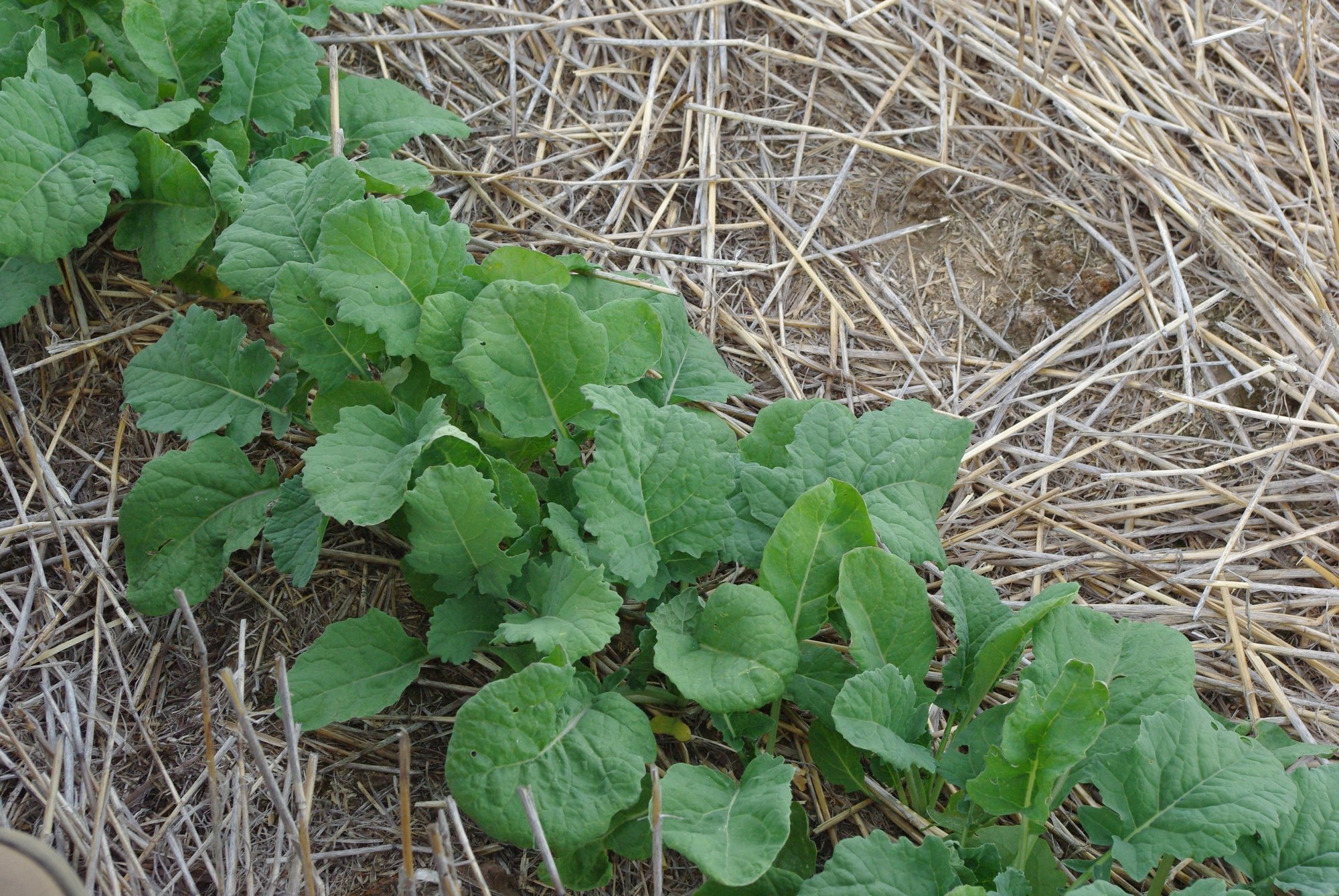
A Note on Timing
Application timing, particularly for winter canola, will depend on many factors including rainfall, soil type, and equipment. As a starting point, make N timing and split application decisions similar to what is used for wheat.
Quick links
Resources
2026 On-Farm Fertilizer Timing Trial
How Much Fertilizer Does Canola Need?
Northern Idaho Fertilizer Guide Spring Canola
Optimizing Fertilizer Application Timing for Winter Canola in Northern Idaho
Northern Idaho Fertilizer Guide Winter Rapeseed
Winter Canola Response to Soil and Fertilizer Nitrogen in Semiarid Mediterranean Conditions
Industry Contacts
- Partner
- Silver
- Associate
- Associate
- Silver
- Silver
- Associate
- Associate
- Associate
- Associate
- Silver
- Associate
- Gold
- Associate
- Platinum
- Silver
- Gold
- Associate
- Gold
- Associate
- Associate
- Platinum
Northwest Grain Growers
Associate-
Weed Control Systems approach, labeled herbicides by application timing, resistance management
A systems approach includes planning crop and chemical rotation to address field-specific weed pressures, minimizing long-term carryover herbicides (particularly Group 2s), and avoiding herbicide-resistant weeds. Always read and follow label directions before using any product.
Labeled Herbicides for Canola in the PNW
-
Preplant incorporated: Sonalan, Treflan
-
Postemergence grass: Assure II, Poast, Select
-
Postemergence broadleaves: Stinger (Canada thistle)
-
Herbicide resistant systems: Liberty Link (glufosinate), Roundup Ready (glyphosate), Clearfield (imazamox)
Resources
Weed Decision Tools and Calculators
Canola and Italian Ryegrass Control
Rotational Restrictions for Canola
Herbicide Carryover Info Sheet
Herbicide Classification Poster
NDSU Canola In-crop Weed Control Guide
Industry Contacts
- Partner
- Silver
- Associate
- Associate
- Associate
- Associate
- Silver
- Associate
- Associate
- Silver
- Silver
- Gold
- Associate
- Associate
- Gold
- Platinum
- Associate
- Silver
- Associate
- Gold
- Associate
- Platinum
Northwest Grain Growers
Associate-
Pests, Pollinators, & Beneficials IPM, economic thresholds, pollinator protection, beneficial insects
Develop an integrated pest management strategy with regular scouting and knowledge of pest life cycles. Populations can increase or decrease quickly, impacting treatment decisions.
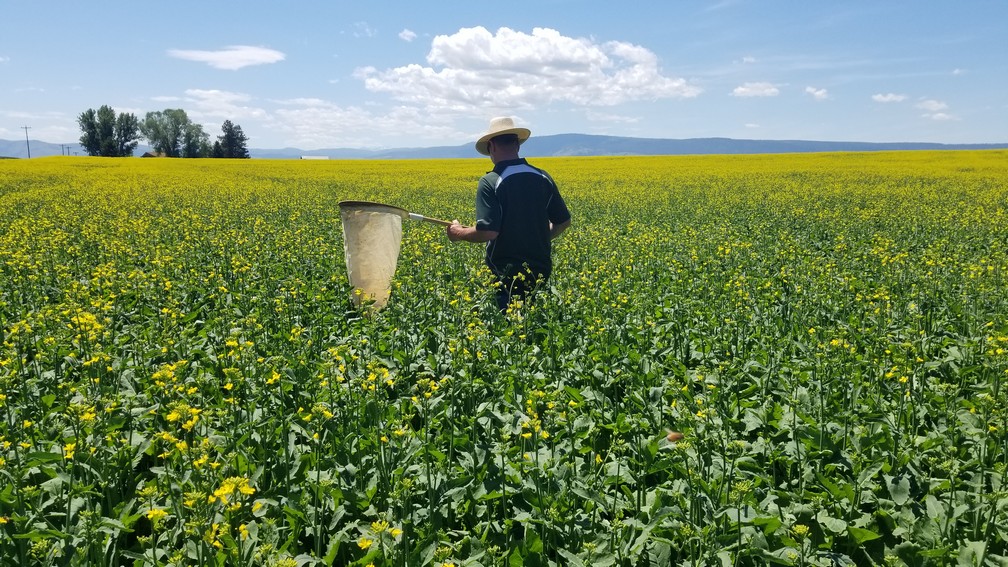
Common pests that may reach economic thresholds:
-
Cabbage aphid
-
Cabbage seedpod weevil
-
Flea beetle
-
Cutworm
-
Diamondback moth
Other observed pests that not often at treatment levels:
-
Lygus bugs
-
Thrips
-
Grasshoppers
-
Blister beetles
-
Armyworms
-
Horned lark (bird)
Beneficial insects:
-
Ladybug beetles
-
Lacewings
-
Parasitic wasps
-
Ground beetles
-
Damsel bugs
Many PNW growers have opted not to apply insecticide after discovering a substantial beneficial population — ladybug nymphs feeding on aphids, for example — and the beneficials provided sufficient natural control. Beneficial insect populations will not build when insecticide is applied every season as a precaution without scouting first.
If spraying is warranted, apply in the evening or early morning using a selective insecticide when possible. Contact the apiarist in advance if honey bee hives are near the field so they can move or cover hives if desired.
Quick Links
Pollinators
Canola is a self-pollinated crop, so only hybrid canola seed production has special pollination requirements. There is ample anecdotal evidence of increased yield when pollinators are present. Canola is an excellent forage source for bumblebees, native bees, honey bees, and other pollinators. Beekeepers are taking note of the increasing canola acreage in the PNW and the value of having honey bees forage in canola after being in almond orchards.
Resources
Beneficial Insects & Pest Management (Western Canada)
Cutworm Pests of Crops on the Canadian Prairies: Identification and Management Field Guide
Identifying and Managing Insect Pests of Canola (Dale Whaley, WSU)
Canola Insect Pests (Jim Davis, UI)
Does Seeding Date and Rate of Canola Affect Spring Flea Beetle Pressure, Yield, and Quality?
Insecticide Classification Chart
Industry Contacts
- Silver
- Associate
- Silver
- Silver
- Associate
- Associate
- Associate
- Associate
- Silver
- Associate
- Gold
- Platinum
- Silver
- Gold
- Associate
- Associate
Northwest Grain Growers
Associate-
Diseases Blackleg, sclerotinia, rhizoctonia, clubroot watch, diagnostic labs
Diseases common to canola in other parts of the U.S. and Canada have not gained a strong foothold in the PNW, primarily due to the Mediterranean environment, crop rotation intervals, and seed treatments containing fungicide. Blackleg, rhizoctonia, and sclerotinia have all been observed in some PNW areas.
Clubroot watch:
Canadian canola growers are dealing with clubroot, which has the potential to be devastating. PNW growers near Canada should keep close tabs on this every year. When blackleg established in Canada it was attributed to growers tightening rotations to one or no crops between canola. Recommendation: at least 3, preferably 4 crops between canola in the same field.
Seed certification required:
All seed sold in ID, OR, and WA requires a certificate declaring the seed disease-free. Do not purchase seed that does not have a certificate.
The land grant universities in the PNW all have diagnostic clinics at the main campus and/or branch campus locations. Diagnosticians are expert at identifying plant, pest, and disease questions that arise particularly during the growing season but also year-round.
Diagnostic Labs in the PNW
The land grant universities in the PNW all have diagnostic clinics at the main campus and/or branch campus locations. The diagnosticians are expert at identifying plant, pest, and disease questions that arise particularly during the growing season but also year-round. Click on the link to the clinic nearest you to find out details such as fee schedules and how to submit samples.
Resources
WSU Puyallup Plant & Insect Diagnostic Lab
University of Idaho Parma Plant Pathology
Fungicide Timing and Rate to Control Blackleg Disease in Winter Canola
OSU Corvallis Plant Clinic
Pacific Northwest Plant Disease Management Handbook
Fungicide Classification Poster
Industry Contacts
- Partner
- Associate
- Silver
- Associate
- Silver
- Silver
- Platinum
- Silver
- Associate
- Associate
- Silver
- Associate
- Associate
- Platinum
- Associate
- Silver
- Associate
- Platinum
- Silver
- Gold
- Associate
- Gold
Growth & Development Growth stages, vernalization, frost and heat events, yield estimation
Canola is very different from wheat. It is worth spending more time in the field at all growth stages to become familiar with what looks right and what may need attention — nutrient deficiency, pest scouting, etc. Canola emergence can be sporadic depending on weather and seeding uniformity, but the compensatory growth habit means it fills in spaces well.
Growth Stages
Most residual herbicide and nutrient deficiency symptoms will be visible by the 4–6 leaf stage, and as late as bolting and stem elongation.
-
Seedling
-
Rosette
-
Bud initiation/bolting
-
Stem elongation
-
Flowering
-
Pod fill
-
Ripening
-
Maturity
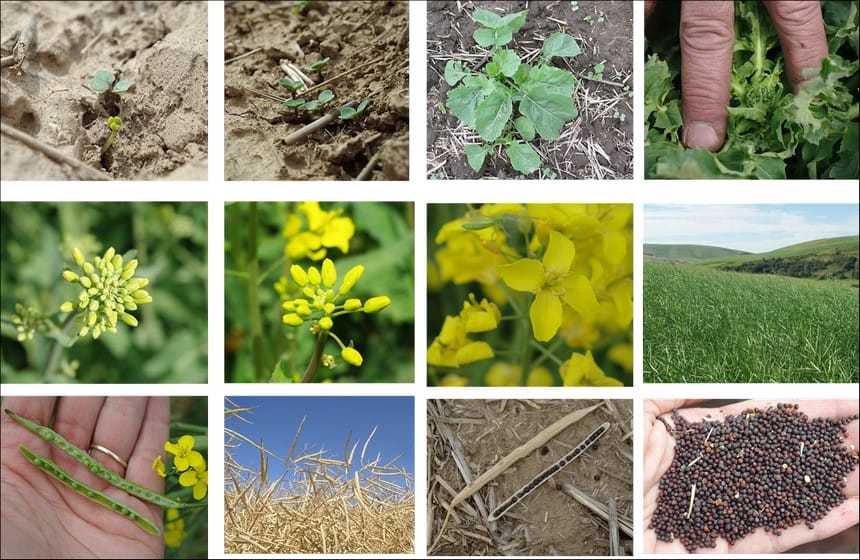
Winter Canola Notes
A comment often heard from first-time winter canola growers: "I'm sure glad someone told me the canola would look and smell horrible going into winter!" Once a hard frost occurs, leaves begin to die back with the aroma of rotting cabbage (sulfur-like). The canola vernalizes like winter wheat before resuming growth in spring.
Frost & Heat During Flowering
-
Flowering can last from a couple of weeks to six weeks depending on temperature.
-
A frost event during flowering causes the plant to droop, then grow upright again — creating an 'S' shaped stalk curve. Does not affect yield unless frost events are continuous.
-
Flowers open during frost will abort and not produce a viable pod.
-
Temperatures above 85°F during flowering will also cause aborted pods.
If questions arise during the growing season, contact your local Extension service, neighboring canola growers, crop input supplier, university staff, or other regional canola experts.
Rough Yield Estimation (Once Pod Formation is Complete)
-
# of pods on main stem × 40 = winter canola yield in lbs/acre
-
# of pods on main stem × 50 = spring canola yield in lbs/acre
-
"Hands of pods on main stem" = 5 bu/acre (250 lbs/acre) per hand
"You need to be willing to put time into learning about the crop and not treat it second-hand."
– PNW canola grower
Resources
Canola Growth and Development Poster
Industry Contacts
- Gold
- Gold
- Silver
- Platinum
- Silver
- Platinum
- Gold
- Silver
- Silver
- Platinum
Harvest Strategies Direct cut vs. swathing, timing, pod sealant, combine settings, storage
Winter canola is harvested from late June through August; spring canola in July–September, some years into October. When canola is ready, it is imperative to have machinery ready to go — delays risk shattering losses. Canola is ready to harvest when the majority of pods from top to bottom can be easily hand-threshed and seeds are brown to black. Stalks will likely still be light to medium green — avoid waiting until the stalks dry down.
Direct Cut vs. Swathing
The choice is often driven by time, weather, and personal preference. Canola settings are listed in most combine manuals as a starting point. Harvest speed is slower than with small grains, particularly in dense stands, when stalks are thick, or when stalks are green. Adjustments will likely be needed for moisture, slope, and variety.
Direct Cut
The majority of spring and winter canola in the PNW is direct cut. Requires uniform crop maturity. Using a auger header with full-width fingers or draper header with a top auger is highly recommended. Specialty headers with extended knife bars can be beneficial for reducing harvest losses, but are not required.
Swathing
More common in Montana, irrigated winter canola in Washington, and the Willamette Valley. Ideal timing: 1/3 brown seed — the lower third of the pod canopy has brown seed. Some areas also use 'pushing' — similar to swathing but crimps rather than cuts the stalks. Swathing improves harvest conditions consistency, but requires an additional operation and equipment.
Combine Settings
One constant with harvesting canola is going slowly enough for the stalks and other plant material to get through the machine without losing too much seed in the process. A good starting point for harvest settings is the combine user manual. Similar to harvesting other crops, there are many variables that go into finding what works most efficiently for canola in a given field - time of day, slope, crop density, header type, and more.
Storage
-
Before harvest, clean bins, inspect aeration, and cover/plug any holes
-
Store at a maximum of 8% moisture and 10°C or below
-
Whenever possible store in bins with aeration
-
Turn on aeration fans as soon as canola is loaded into bins
"Canola is not always more valuable than wheat until you look at the whole picture."
– Wade Troutman, Bridgeport, WA
Resources
The Combine Forum
Harvesting Canola (presentation by Wilbur, WA grower Jesse Brunner)
Combine Optimization Tool
Industry Contacts
- Silver
- Silver
- Gold
- Associate
- Gold
- Silver
- Associate
- Silver
- Silver
- Silver
- Associate
- Platinum
- Associate
- Silver
- Platinum
- Associate
- Platinum
- Gold
- Silver
- Platinum
- Silver