
Production Strategies
Canola in the Pacific Northwest: An opportunity crop
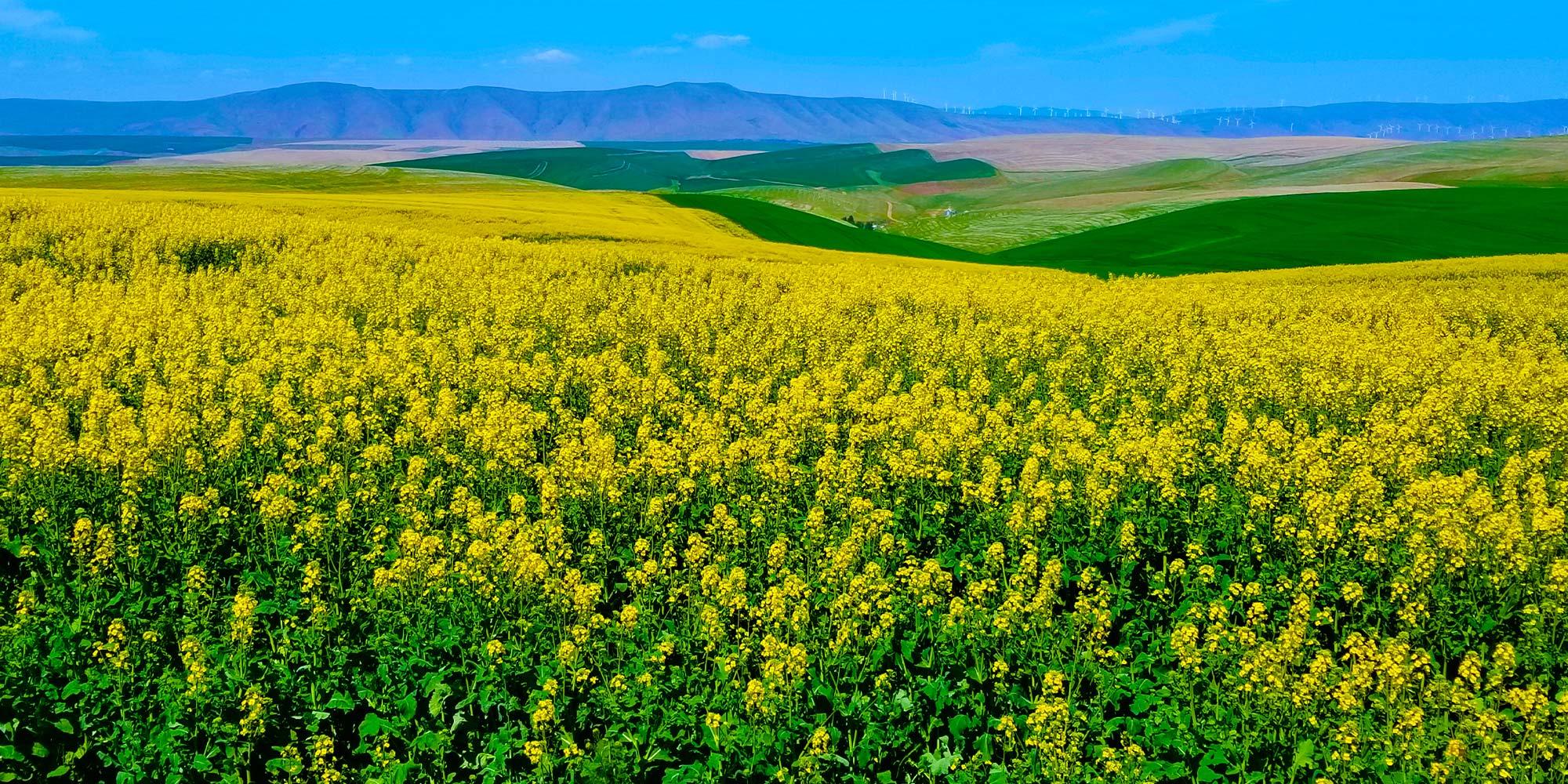
The Pacific Northwest is different from any other canola production region in the U.S. and Canada in that both spring and winter canola can be grown successfully, opening the door for crop rotation opportunities with canola in a wide range of environments and cropping systems. Spring canola production is concentrated in the annual cropping regions of eastern Washington and northern Idaho, and all of Montana. Winter canola is grown in lower rainfall, crop-fallow regions of Idaho, Oregon, eastern Washington, and scattered areas of Montana, as well as the Willamette Valley in western Oregon. It is also utilized as a deficit irrigation crop where water is limited, e.g. deep-well areas of eastern Washington.
Yield potential of winter canola is often cited as double that of spring canola; however, that figure can vary widely depending on several factors, primarily available water during the growing season. In the low rainfall, wheat-fallow regions, winter canola can yield from 1,500-3,000 lbs/acre (30-60 bu/acre). Deficit irrigated winter canola average yield is 4,000 lbs/acre (80 bu/acre) while in the Willamette Valley of western Oregon yields of 4,000-5,500 lbs/acre (80-110 bu/acre) have been reported. Spring canola may only yield 1,000 lbs/acre (20 bu/acre) or less in a dry year, and with higher rainfall average can yield up to 3,000 lbs/acre (60 bu/acre).
If you have not yet tried canola, keep in mind when working through the decision making process that there is no one ‘right’ answer to a lot of questions you may have about growing canola. It is important to network with other canola growers and learn from their experiences, go to field tours and workshops, and peruse canola production information on this website and others. ‘Canola is an opportunity crop’ is a common statement from seasoned canola growers – and can be defined by economics, planting conditions, crop rotation, and other factors, and when most or all of those line up, take advantage of the opportunity!
The information below contains strategies, links to publications, and other insights that can be utilized whether you are a first-time or experienced canola grower, crop advisor, or input supplier. It is not intended to be comprehensive, but rather an evolving source of information over time. If you have suggestions for additional information to include, or are willing to share anything you have learned from growing canola please email pnwcanola@gmail.com.
Getting Started
Once the decision has been made to include canola in your crop rotation, what are the next steps to get started? The following statement from a canola grower in eastern Washington sums up a bigger picture perspective about canola production:
“Growing canola requires a different way of thinking, from a systems approach - chemical systems, cropping systems, rotational systems.”
Why Grow Canola? Benefits
The benefits of growing canola are well documented in the Pacific Northwest. While not an exhaustive list, the following benefits are often listed by farmers for reasons they started and continue to grow canola in the PNW:
- Crop rotation – canola is a broadleaf crop that introduces diversity, particularly in the cereal-dominated cropping systems common to the PNW.
- Chemical rotation – canola provides an opportunity to use herbicides that aren’t used in cereal rotations.
- Improved weed management – the ability to use different chemistries, and different timing of weed control than in a monoculture rotation can significantly improve control of problem weed populations and decrease the chance of herbicide resistance.
- Yield increase in subsequent wheat/cereal crop – while there are a few reports of reduced yield in crops following canola, most growers comment on improved yield the year after canola, and often two years after canola.
- Economics – with canola markets holding fairly steady compared to other commodities such as wheat and garbanzo beans, most enterprise budget calculations end up with a positive bottom line when canola is in the crop rotation.
- Break disease and pest cycles – canola serves as a ‘break crop’ in wheat and other cereal rotations where disease and pests have built up to economically damaging levels.
- Irrigation timing – in deficit irrigation systems, canola needs water at different times than when potatoes or wheat need water
- Improved soil structure and health – the taproot of canola can break up tillage and hard pans, and the entire root system is very efficient at taking up nutrients that are not accessible by wheat roots.
- Snow capture and residue decomposition – standing canola stalks are great for catching snow, and also decompose fairly readily, allowing for easier no-till seeding.
- Increased water infiltration – the taproot opens up more channels for water to move down into the profile, reducing the chance of erosion and improving soil structure for subsequent crops.
- No need to purchase new equipment – while modifications may need made to existing equipment, you can use what you have for wheat and other crops.
- LOCAL demand – having processors in MT and WA reduces transportation cost for many growers in the PNW.


